10+
Case Studies in Knowledge Base
6
System Prompt Iterations
40+
Conversation Topics Covered
3
Days from Concept to Live
Client
Personal Project
Role
Designer + Builder
Methods & Disciplines
Tools Used
A portfolio is a passive artifact. Visitors scroll, skim, and leave with whatever they happen to land on. I wanted to ask a different question: what if my portfolio could have a conversation? BR(AI)N is an AI chat experience I built into this site and trained on my full body of work. It is designed to represent my voice, thinking, and approach in real time, so every visitor gets the answer to the question they actually came to ask.
Every person who visits my portfolio comes with a different question. A recruiter wants to know about leadership and scale. A client wants to understand process. A collaborator might be looking for specific domain experience. No portfolio layout serves all of them equally well. My challenge was to create an experience that meets visitors where they are, answers their specific questions, and gives them a sense of how I think, not just what I have made.
I started by defining scope and guardrails: the AI needed to represent me accurately, stay within its knowledge base, and never fabricate. I wrote voice and personality guidelines before writing any code.
I designed the knowledge architecture: a structured system prompt covering my background, 10+ case studies, 30+ client history by industry, my process philosophy, and explicit guidance for edge cases like off-topic questions.
I iterated on persona and tone across multiple prompt versions. The AI needed to sound like me, direct and specific, not like a generic assistant. I treated prompt engineering as a design artifact with the same rigor as any content spec.
I built the API integration: a Next.js API route calling the Gemini API directly via fetch. I handled alternating message format requirements, initial greeting exclusion, and baked progressive disclosure coaching into the prompt itself.
I designed the chat UI: a branded panel with my photo as the avatar, the 'BR(AI)N' name with yellow on (AI) to signal self-awareness, preset prompts as designed entry points, and a compact trigger button that doesn't compete with the portfolio content.
I added GA4 event tracking for chat open, message sent, and preset prompt clicks to measure real engagement and inform future prompt refinements.
Key Decisions
1
The system prompt is the design artifact. I spent more time writing, structuring, and refining the prompt than on any other part of the build. It determines whether the AI sounds like me or like a generic bot. Every revision was a design decision.
2
Preset prompts are not shortcuts, they are entry points. I chose each one to surface a different dimension of my work: a specific project, a process question, a philosophy question. They give visitors who do not know what to ask a useful place to start.
3
The name and branding matter. BR(AI)N makes the AI nature explicit and a little playful. It signals that this is my feature, not a generic chatbot bolt-on. That framing shapes how visitors engage with it from the first moment they see the trigger button.
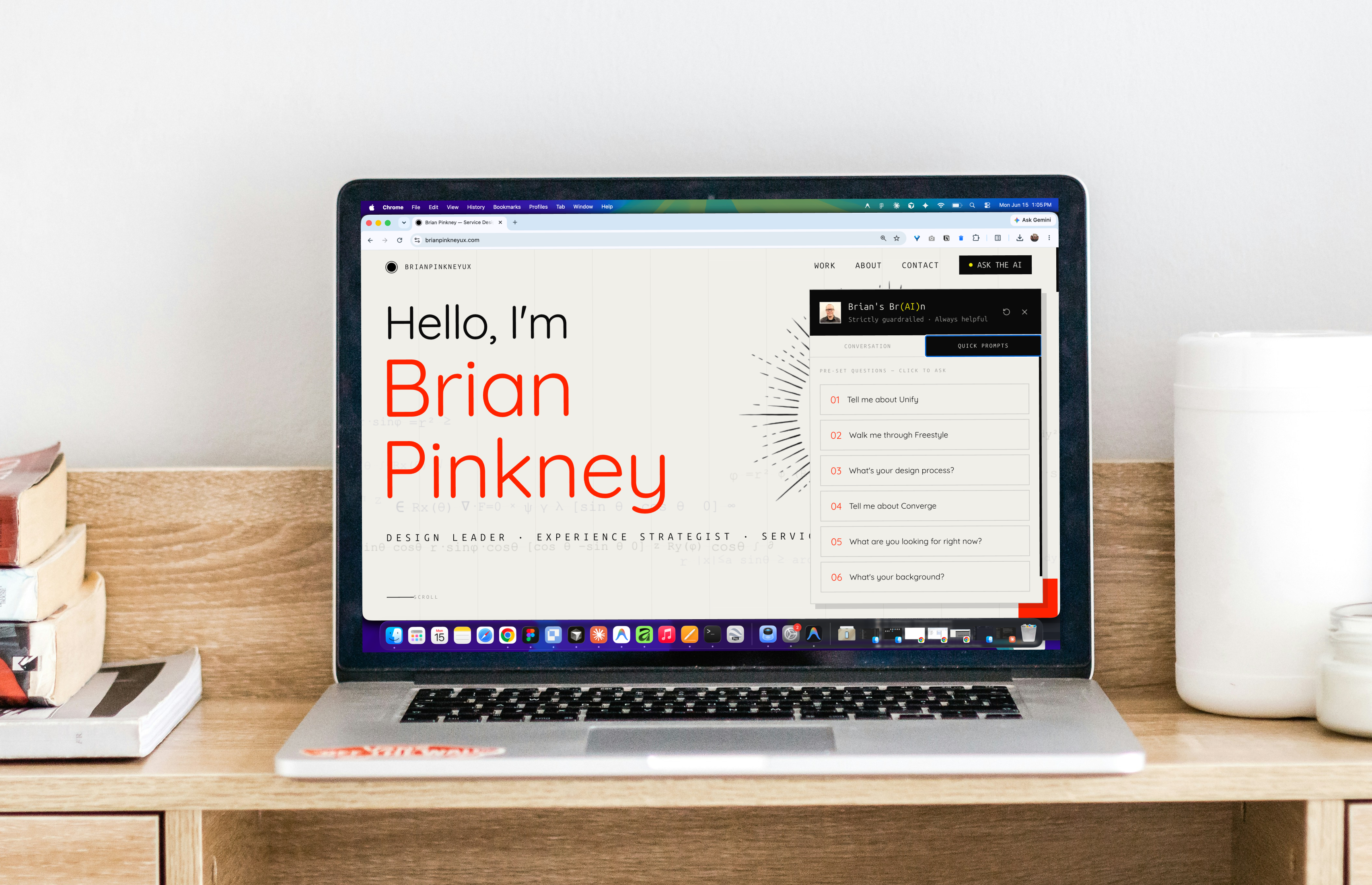
The chat interface and conversation design working together as a single experience.
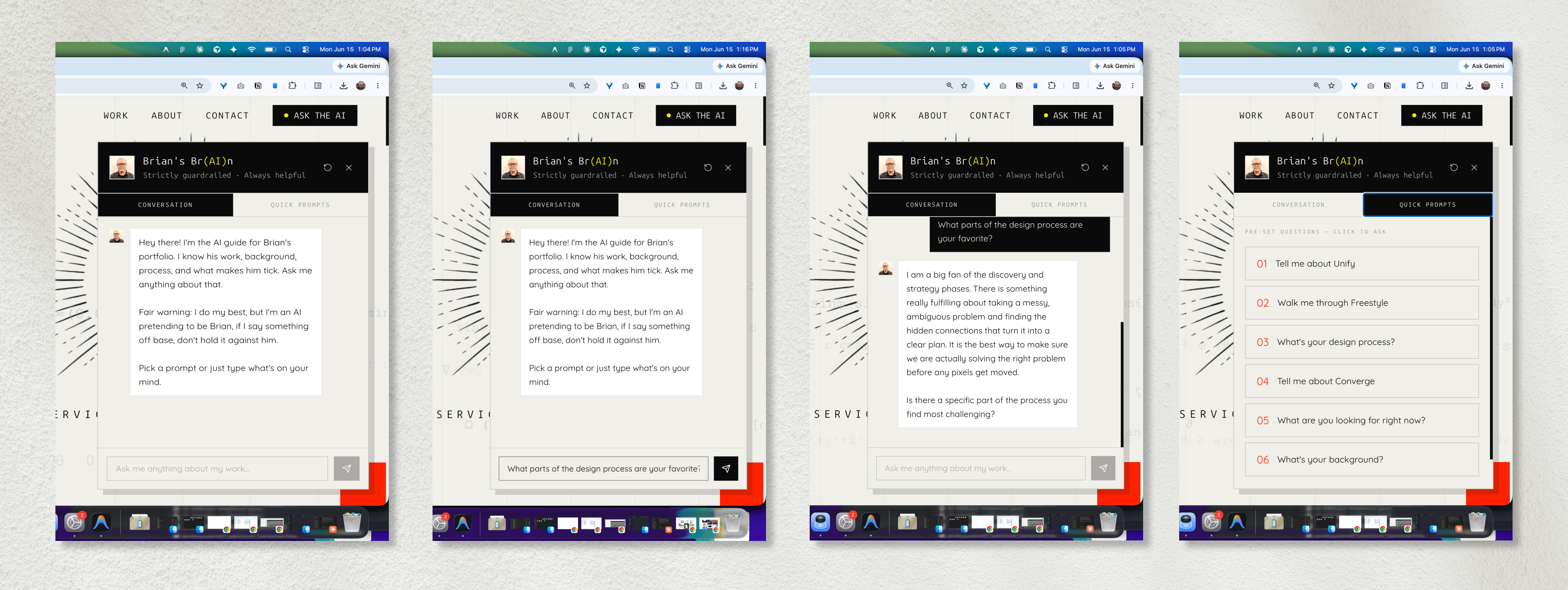
The BR(AI)N panel open on the portfolio homepage. Photo avatar header, preset prompt entry points, and conversation area designed to feel like a direct extension of the site, not a third-party widget.
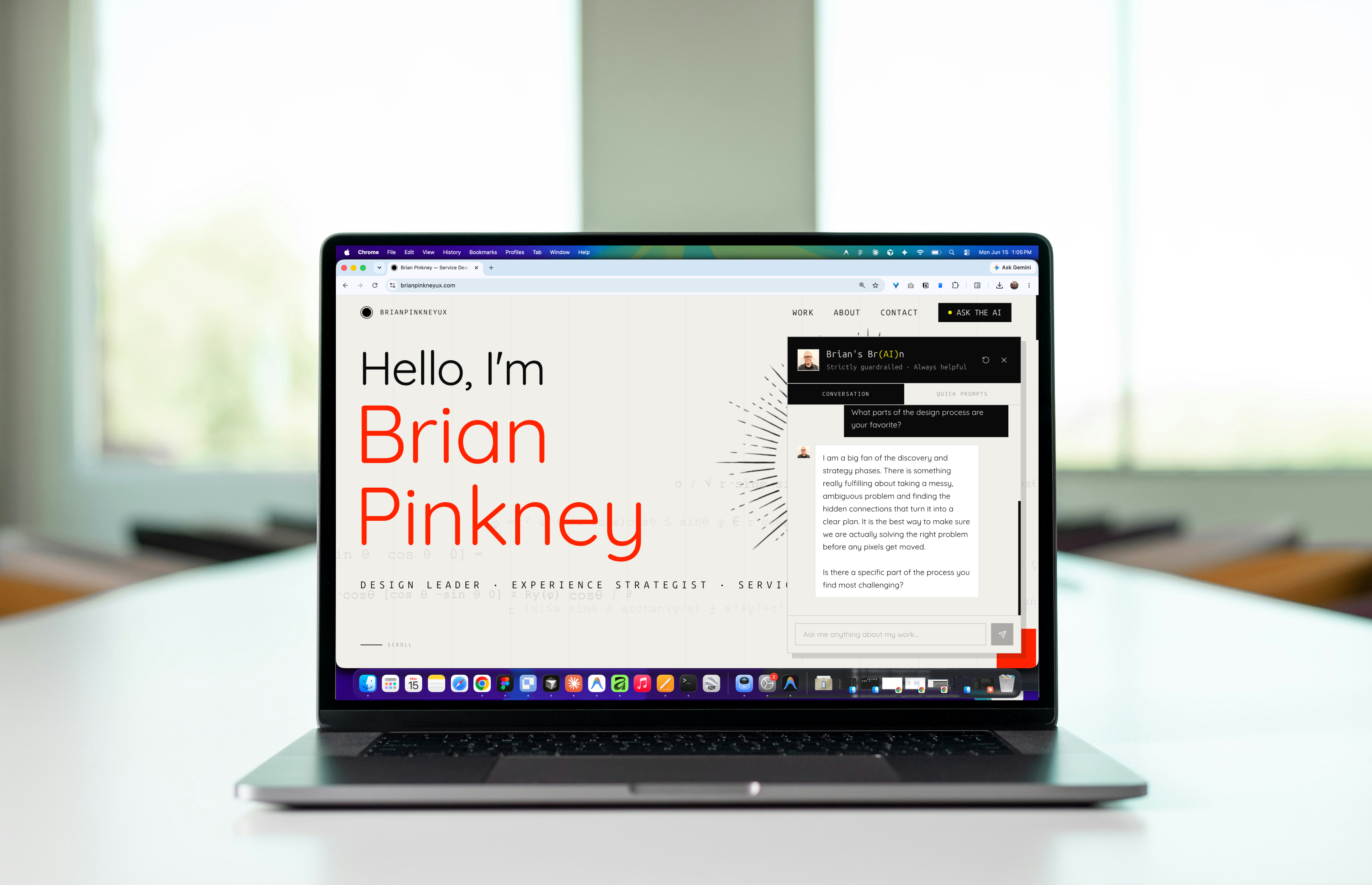
Full desktop view with the chat panel expanded. Preset prompts surface different dimensions of my work so visitors who do not know what to ask still have a useful starting point.
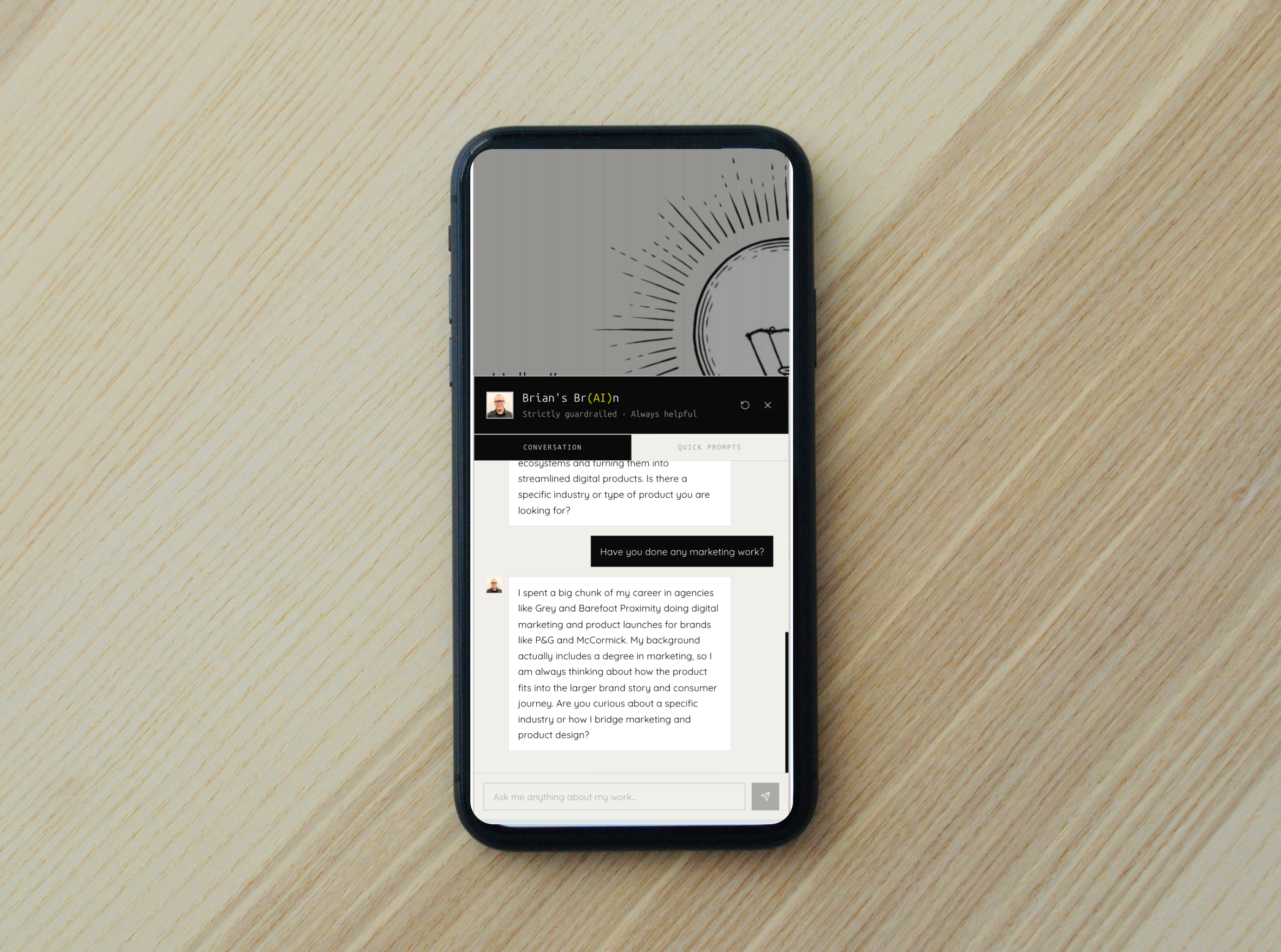
The same preset entry points and branded header on mobile, optimized for touch without sacrificing the persona or conversation flow.
A screen recording of the live chat experience: opening the panel, using preset prompts, and asking follow-up questions about my work and process.
Building BR(AI)N made something concrete for me: designing AI systems requires the same rigor as designing any other experience. The system prompt is a content strategy problem. The conversation flow is a UX challenge. The persona is a brand decision. When someone asks whether I have worked with AI, the answer is not a slide in a case study. It is the tool they are using right now.
BR(AI)N turned my passive portfolio into an active conversation. Visitors can ask the specific question they have, get a real answer, and leave with a clearer picture of how I work and think. The feature also functions as a live demonstration of the design and systems thinking it describes, making the portfolio itself an artifact of the work.
Next Project — SERVICE DESIGN
UNIFY
Kroger POS Launch Automation with Agentic AI

Brian Pinkney
10+
Years leading teams
6+
Industry Awards Won
8
Business Sectors Served
20+
Countries & Markets
Sectors
IMAGINE.
CREATE.
EXPERIENCE.
I'm a design leader and experience strategist with 20+ years in product design, user experience, and strategy. Over that time I've worked with dozens of companies and brands across healthcare, retail, advertising, and innovation consulting, most recently leading experience work at Kroger, with prior roles at Cardinal Health and Grey. I'm a bit of a Swiss army knife. I design what people see, but I also design the systems behind it: the people, processes, and decisions that shape how an experience actually feels.
Right now I'm focused on the evolving relationship between humans and AI. I'm especially interested in Agentic Experience Design, moving past chatbots toward AI systems that act with intent, transparency, and real utility, with humans firmly in the driver's seat. I think a lot about the UX of delegation, the feedback loops that build trust between people and agents, and what 'Responsible AI' looks like when it's designed in from the start instead of bolted on at the end.
I like the unglamorous detail. The hand-off between teams that quietly breaks a customer's trust. The data model that decides what a frontline worker can actually see. The back-of-stage process that creates the experience a user never notices but always feels. I'm comfortable in a service blueprint, a stakeholder boardroom, a Figma file, or a terminal running Claude Code.
AI & Emerging Tech
- Agentic Experience Design
- UX for AI
- Responsible AI Frameworks
- AI Strategy (MIT / Wharton certified)
- Human-AI Interaction Patterns
Service Design
- Service Blueprinting
- Journey Mapping
- Ecosystem Mapping
- Co-design Facilitation
- Systems Thinking
Research & Strategy
- Discovery & User Research
- Contextual Inquiry
- Experience Strategy
- Data-Driven Design
- KPI & Metrics Strategy
Design & Craft
- UX / UI Design
- Interaction Design
- Figma (Advanced)
- Design Systems at Scale
- Rapid Prototyping
Build & Tooling
- Cursor
- Claude Code
- Tailwind CSS
- HTML / CSS / JavaScript
- Figma-to-Code Workflows
Leadership & Ops
- Product Design Leadership
- Team Management & Mentorship
- Workshop Facilitation (LUMA certified)
- Stakeholder Alignment
- Design Operations
Education & Recognition
BBA, Marketing — Ohio University
Human-Centered Design Practitioner — LUMA Institute
AI: Implications for Business Strategy — MIT Sloan School of Management
AI Strategy and Governance — University of Pennsylvania, Wharton School
AI for Product Management Specialization — Duke University
Agentic AI for Leadership — Virginia Tech
