SOURCING
Kroger Enterprise Sourcing: Vendor Ecosystem Design
$900k
Estimated Savings Over 2 Years
$1M+
Savings Per New Category / Year
30+
Stakeholders Interviewed
47
Ecosystem Touchpoints Mapped
Client
Kroger Enterprise Sourcing
Role
Lead Service Designer & Strategist
Methods & Disciplines
Tools Used
Kroger's Enterprise Sourcing group sources quality partners to supply products and services across Kroger stores. But fragmented modernizations happening in silos, legacy systems, and disconnected data made it impossible to build toward anything unified. I led discovery, service design, and strategy to define the future vision of the vendor management ecosystem and all connected experiences.
The sourcing organization was modernizing. Just not together. Different teams were solving the same problems independently, building tools that didn't talk to each other, and managing vendor relationships through processes that hadn't scaled with the business. The real challenge wasn't any single system. It was the absence of a shared vision for how vendors, internal teams, data, and technology should connect.
Conducted discovery interviews with sourcing managers, category strategists, buyers, and vendors to understand daily workflows, tool gaps, and pain points. Identified opportunities for better data access, efficiency improvements, and unmet needs across the ecosystem.
Assembled a cross-functional team of researchers and service designers to build a comprehensive ecosystem map spanning every organizational touchpoint, surfacing previously unrecognized friction, handoff failures, and opportunities that no single team could see on their own.
Facilitated design thinking and systems workshops to envision a connected vendor ecosystem. Explored dynamic, personalized, and automated capabilities (ranging from near-term wins to ambitious moonshots) and developed a unified North Star vision to align stakeholders.
Identified core data sources impacting daily business decisions across sourcing and vendor management. Matched insights to data sources to define a phased roadmap for shared data schemas, AI integrations, and platform modernization.
Interviews and collaborative workshops across sourcing managers, category strategists, buyers, and vendors surfaced a landscape of disconnected systems, unclear ownership, and untapped opportunity.
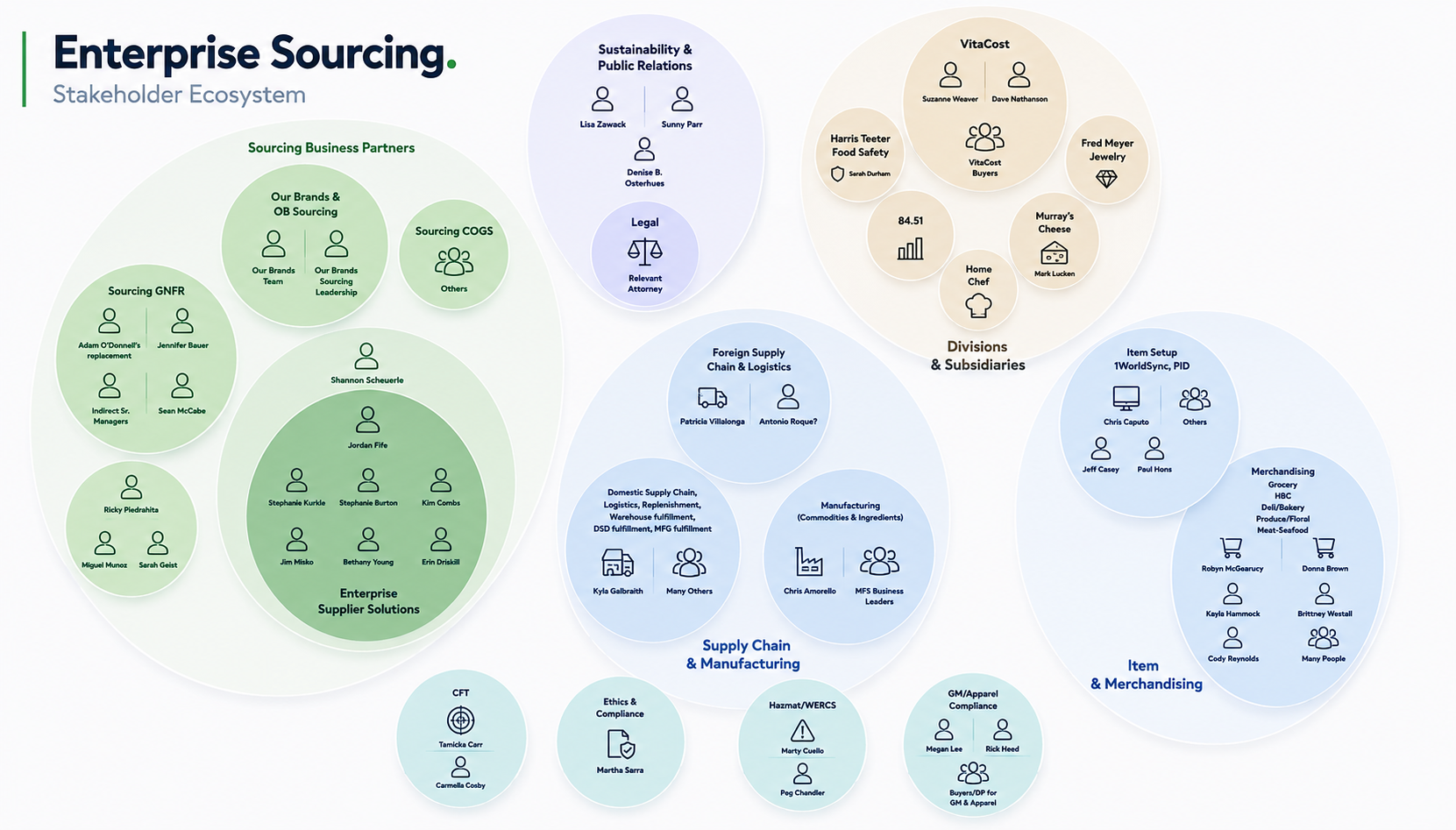
Mapping the full range of stakeholders across the sourcing organization, including internal teams, vendors, and supporting systems, to identify key relationships, influence points, and where alignment was missing.
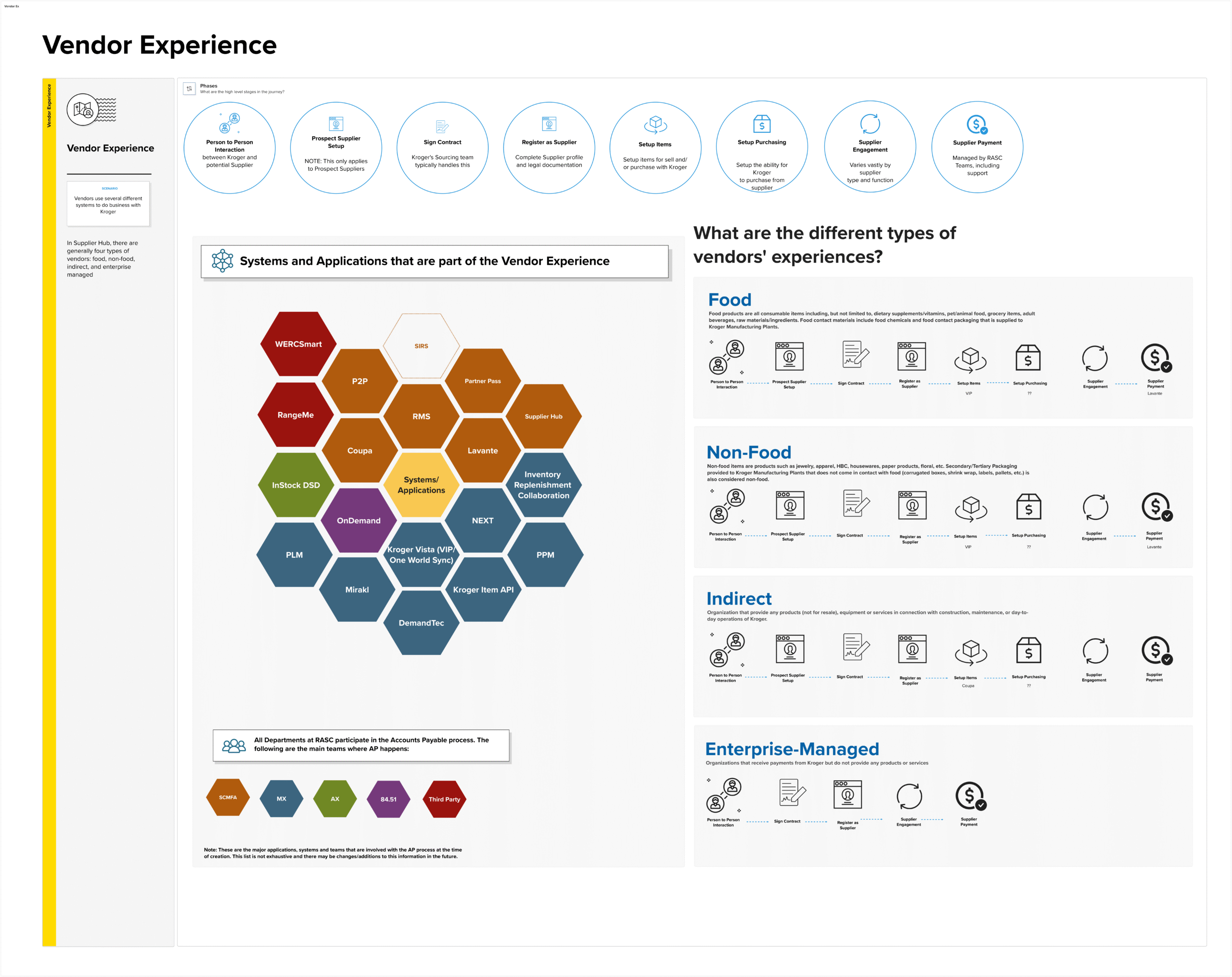
The end-to-end vendor experience charting touchpoints, friction, and opportunities across the full sourcing lifecycle, from initial partner identification through ongoing relationship management.
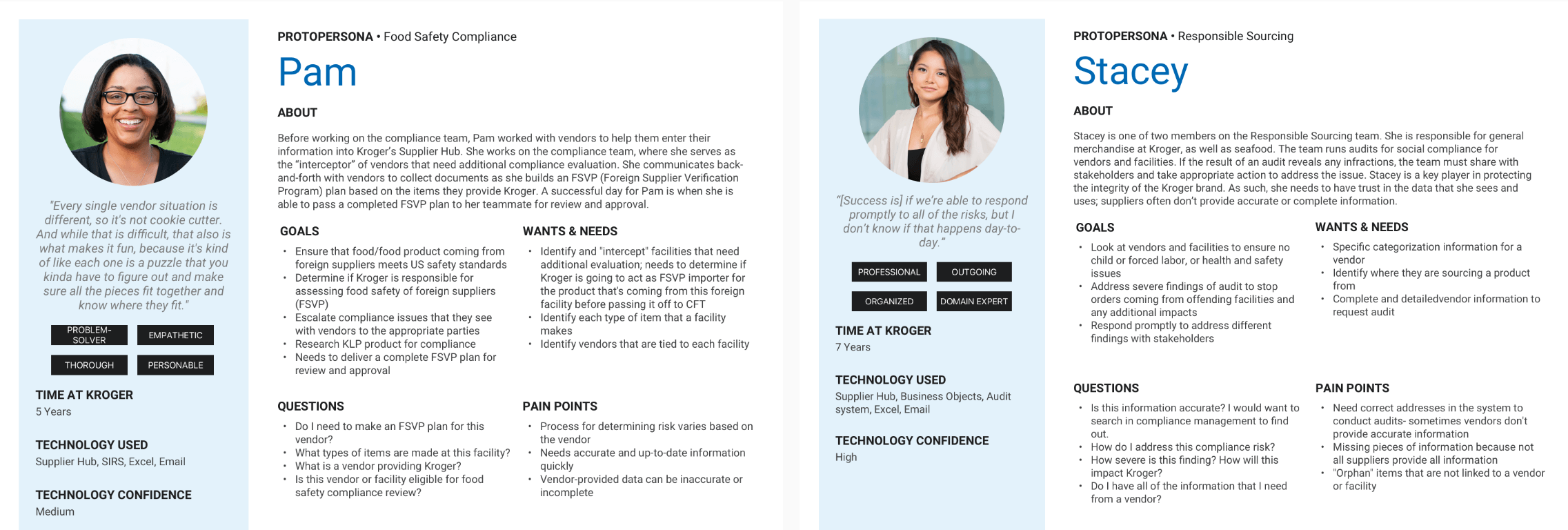
Synthesizing interview findings into a set of distinct personas across sourcing managers, category strategists, buyers, and vendors, grounding design decisions in the real motivations, frustrations, and needs of the people doing the work.
Key Findings
6
Distinct vendor touchpoints mapped across the sourcing lifecycle, from initial partner identification through ongoing relationship management. Most friction clustered at handoffs between teams with no shared system of record.
11
Siloed modernization efforts identified across business units, each solving overlapping problems independently without a shared framework or data strategy to connect them.
36
Potential automation and AI integration opportunities identified across contract management, RFP enablement, category evaluation, supplier onboarding, and payments, with a clear prioritization for phased implementation.
The service blueprint and North Star roadmap became the shared artifacts that aligned leadership, product teams, and technology stakeholders around a unified vision for the ecosystem.
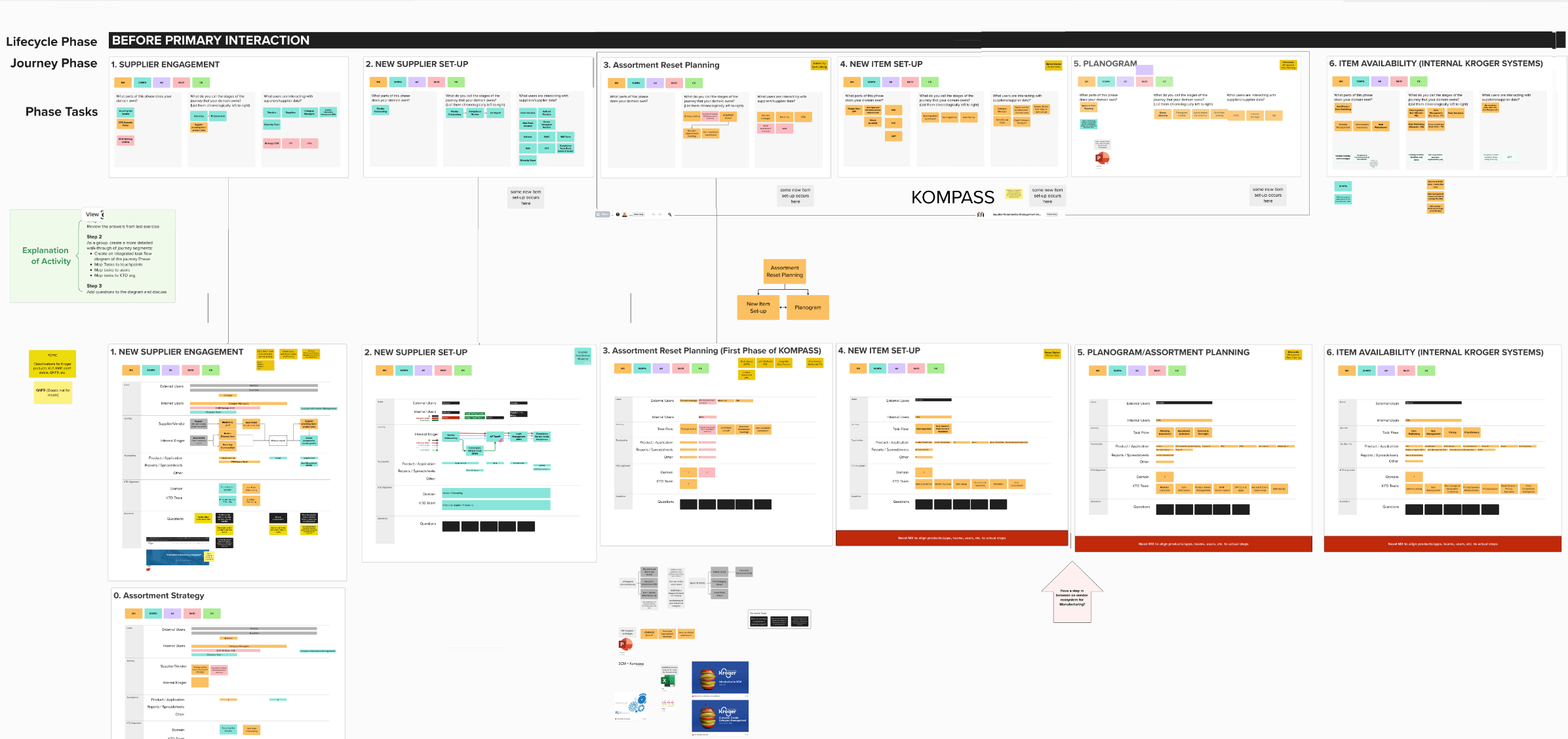
Mapping front-stage vendor interactions, back-stage processes, and supporting systems across the sourcing organization, used to surface transformation opportunities and align teams on the current state before designing toward the future.
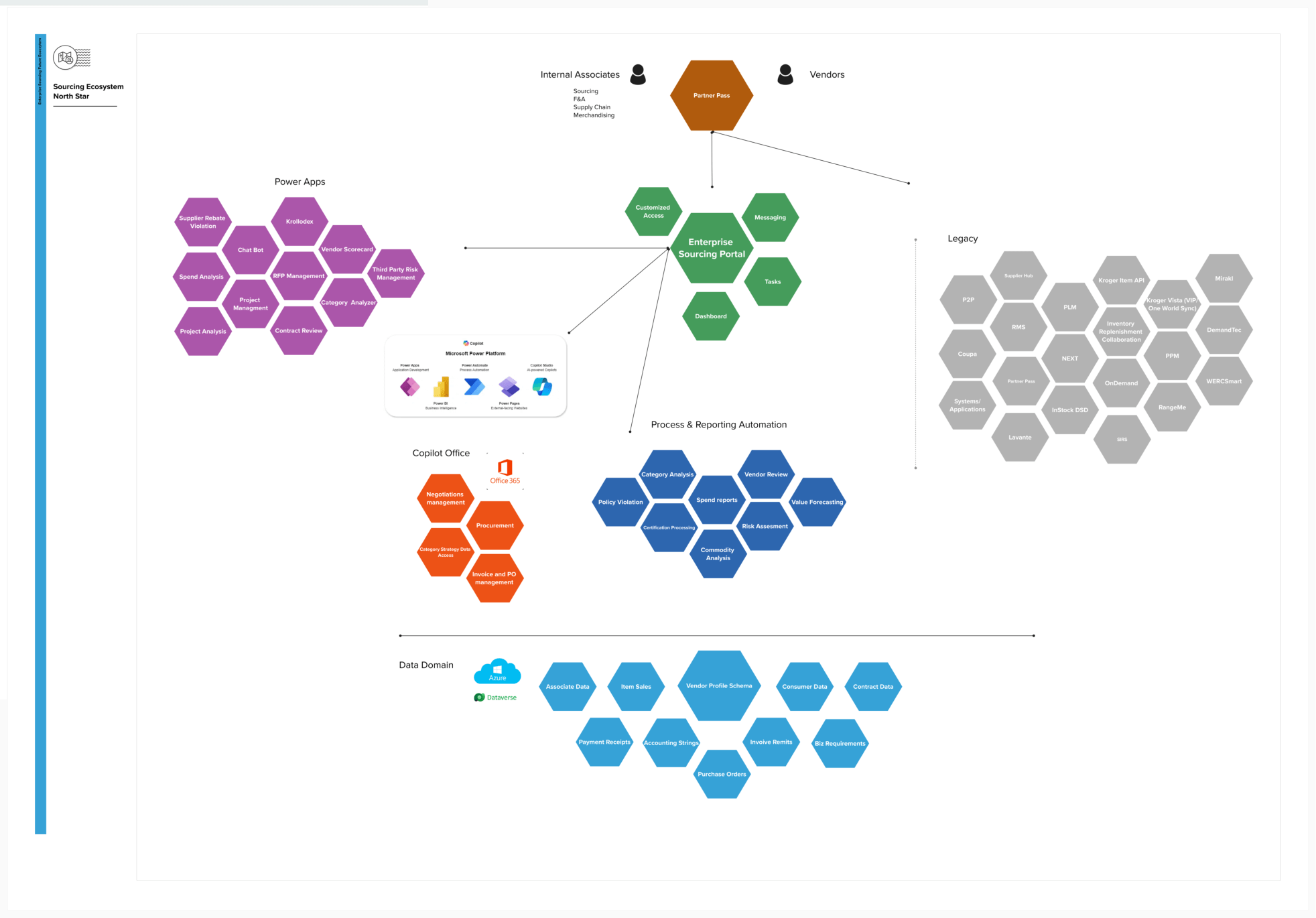
The North Star Vision designed after discovery and synthesis. A unified picture of the future vendor ecosystem used to align leadership and roadmap planning. This artifact anchored the big picture strategy and gave stakeholders a shared reference point for prioritization decisions.
What does the future look like?
AI technology partnerships – Identifying and onboarding AI partners to enable process automation, RFP enablement, contract management automation, category evaluation, and payments and accounting solutions across the sourcing organization.
A reimagined vendor funnel – Rethinking how the organization onboards new suppliers, manages active vendor relationships, and offboards partners, building a consistent, scalable experience across the full lifecycle.
Shared data schemas – Creating unified data structures across business units to drive a shared vendor profile, giving every team the same source of truth and enabling cross-functional insights that weren't possible before.
An integrated ecosystem – Building a connected plan that bridges legacy systems, new application designs, and modern technologies, including low-code platforms like Power Apps for rapid development where speed matters most.
The engagement produced a North Star vision and phased roadmap for a connected vendor ecosystem: unified legacy systems, new application designs, and modern AI capabilities including process automation, RFP enablement, and contract management. Shared data schemas across business units and a redesigned supplier onboarding funnel gave the organization a concrete path forward, not just a vision deck.

Next Project — AI DESIGN
BR(AI)N
Designing an AI Persona for a Portfolio That Talks Back

Brian Pinkney
10+
Years leading teams
6+
Industry Awards Won
8
Business Sectors Served
20+
Countries & Markets
Sectors
IMAGINE.
CREATE.
EXPERIENCE.
I'm a design leader and experience strategist with 20+ years in product design, user experience, and strategy. Over that time I've worked with dozens of companies and brands across healthcare, retail, advertising, and innovation consulting, most recently leading experience work at Kroger, with prior roles at Cardinal Health and Grey. I'm a bit of a Swiss army knife. I design what people see, but I also design the systems behind it: the people, processes, and decisions that shape how an experience actually feels.
Right now I'm focused on the evolving relationship between humans and AI. I'm especially interested in Agentic Experience Design, moving past chatbots toward AI systems that act with intent, transparency, and real utility, with humans firmly in the driver's seat. I think a lot about the UX of delegation, the feedback loops that build trust between people and agents, and what 'Responsible AI' looks like when it's designed in from the start instead of bolted on at the end.
I like the unglamorous detail. The hand-off between teams that quietly breaks a customer's trust. The data model that decides what a frontline worker can actually see. The back-of-stage process that creates the experience a user never notices but always feels. I'm comfortable in a service blueprint, a stakeholder boardroom, a Figma file, or a terminal running Claude Code.
AI & Emerging Tech
- Agentic Experience Design
- UX for AI
- Responsible AI Frameworks
- AI Strategy (MIT / Wharton certified)
- Human-AI Interaction Patterns
Service Design
- Service Blueprinting
- Journey Mapping
- Ecosystem Mapping
- Co-design Facilitation
- Systems Thinking
Research & Strategy
- Discovery & User Research
- Contextual Inquiry
- Experience Strategy
- Data-Driven Design
- KPI & Metrics Strategy
Design & Craft
- UX / UI Design
- Interaction Design
- Figma (Advanced)
- Design Systems at Scale
- Rapid Prototyping
Build & Tooling
- Cursor
- Claude Code
- Tailwind CSS
- HTML / CSS / JavaScript
- Figma-to-Code Workflows
Leadership & Ops
- Product Design Leadership
- Team Management & Mentorship
- Workshop Facilitation (LUMA certified)
- Stakeholder Alignment
- Design Operations
Education & Recognition
BBA, Marketing — Ohio University
Human-Centered Design Practitioner — LUMA Institute
AI: Implications for Business Strategy — MIT Sloan School of Management
AI Strategy and Governance — University of Pennsylvania, Wharton School
AI for Product Management Specialization — Duke University
Agentic AI for Leadership — Virginia Tech
